
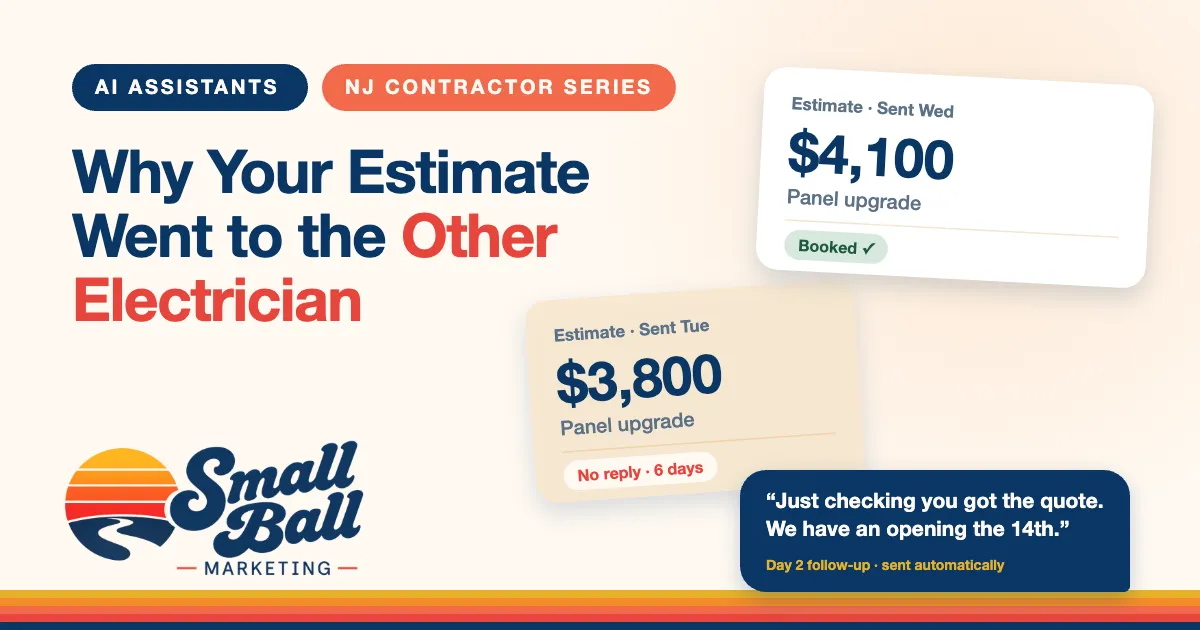
Why Your Estimate Went to the Other Electrician
A homeowner in Wyckoff has been staring at the same cracked panel box for two years. This spring she finally decides to deal with it, and she calls two electricians. The first one shows up on a Tuesday, spends forty minutes in the basement, says "I'll get you a number," and leaves. The second shows up Thursday, does the same thing, and also promises a number.
The first electrician sends his estimate that night from his truck: a PDF, no message, subject line "Estimate." The second electrician sends his the next morning, and then something odd happens. Two days later, a text arrives: "Hi Dana, just checking you got the panel upgrade quote, happy to walk through the options if it helps." Four days after that, one more: "No rush, but we have an opening the week of the 14th if you want to get on the schedule."
Dana hires the second guy. Not because he's cheaper (he wasn't) or better (she has no idea, neither of them has touched the panel yet). She hired him because he was the only one who acted like he wanted the job.
The first electrician is still waiting to hear back. He assumes she went with someone cheaper. He will never know it was a text message.
If you have ever lost an estimate and chalked it up to price, there is a decent chance you have been the first electrician.
That Is the Quote Problem, and Almost Every Contractor Has It
Most owners think of lost jobs as a phone problem: the call that went to voicemail, the lead that never came in. We covered that one in The $27,000 Voicemail, and it is real. But there is a quieter leak sitting one step further down the funnel, and it is almost entirely self-inflicted.
It is the estimate that goes out and then goes silent.
You did the hard part. You paid for the lead or earned the referral, you drove out, you spent an hour on site, you wrote it up. The customer was interested enough to let you into their house. And then the whole thing hinges on whether somebody remembers to send a second message, from a truck, between jobs, three weeks into a busy season, with fourteen other quotes floating around in a text thread and an email inbox and one very optimistic Post-it.
Somebody won't. That is not a character flaw. That is arithmetic.
The Math Nobody Runs (Again)
Here is an illustrative example. Swap in your own numbers, because the point is the shape of it, not the digits.
Say you run a two-truck shop in Bergen or Monmouth County. You send about fifteen estimates a month, the average job is $3,800 (mini-split install, water heater swap, panel upgrade, the kind of work that fills a calendar), and you close four of those fifteen. That is a decent close rate. Nobody is embarrassed by that.
Now suppose you follow up on every single estimate, on a schedule, without fail. You do not become a different company. You do not discount anything. You just stay in the conversation a little longer than the other guy. If that wins you one extra job every two months, you are looking at six extra jobs a year.
Six jobs at $3,800 is $22,800. For sending some text messages.
And that number is conservative, because it ignores the other thing a closed job brings: the customer who calls you first for the next ten years.
Why Good Contractors Still Drop the Ball
There is a long-running piece of research out of Harvard Business Review that looked at how companies respond to inbound leads, and the findings are a little brutal. Across 2,241 companies, the average response time was 42 hours. Nearly a quarter never responded at all. And the firms that reached out within an hour were nearly seven times as likely to qualify the lead as the ones that waited even one hour longer.
That study is from 2011, so take the exact figures with a grain of salt. But look at what has not changed. Customers still talk to a few contractors, they still go with whoever feels responsive, and a number of vendor surveys in the home services world keep landing on roughly the same finding: most homeowners hire the first business that gets back to them. The technology got fancier. The human behavior did not move an inch.
Here is why it keeps happening to people who are otherwise excellent at their jobs.
You are not in the office. Your best salesperson is also your best installer, and he cannot do both at 2 p.m. on a Wednesday. Follow-up is the first thing to slide when the schedule gets tight, because nobody is yelling about it. A customer who is quietly deciding not to hire you does not send an email about it. They just stop answering.
And awkwardness is a factor. Plenty of owners avoid the second text because it feels pushy. It is not. A homeowner staring at three quotes is relieved when one contractor makes the decision easier. Nobody was ever offended by "just checking you got it."
Where an AI Assistant Fits (and Where It Doesn't)
This is the part where most articles start waving their arms about the future. Let's stay on the ground.
A follow-up assistant, built properly inside your CRM, does a handful of unglamorous things. When an estimate goes out, it starts a clock. If the customer has not replied in two days, it sends a short, human-sounding text, using their name and the actual job. If they reply with a question ("does this include the permit?"), it answers what it can from your price book and your standard terms, and flags anything it can't for you or your office manager. If they say yes, it offers open slots from your real calendar. If they go quiet, it checks back a few more times over a couple of weeks, then stops. It does not nag forever, and it never hounds somebody who has said no.
Every one of those messages lands in the same CRM record as the estimate, so when you call Dana back, you can see exactly what was said.
That is it. It is not strategy. It is the follow-up you would do yourself if you had an extra pair of hands and no other job.
What it does not do: negotiate a bid, decide to discount, diagnose a problem from a photo, or replace the relationship you build in the first forty minutes on site. Your trucks, your trust, and your judgment are the product. The assistant is just there so a good estimate does not die of neglect.
Before You Buy Anything: What to Watch Out For
This is the section the vendors skip.
Automation can make a bad process faster. If your estimates are slow to go out, confusing, or arrive without a clear next step, a follow-up tool will just send more messages about a weak quote. Fix the quote first. A one-page estimate with a clear total, a clear start date, and a single "reply YES to get on the schedule" line does half the work on its own.
Watch the tone. If your follow-ups read like a mortgage broker's drip campaign, homeowners will smell it. Messages should sound like you on your best day: short, specific, signed with a real name.
Make sure it stops. A good system pauses the instant a customer replies, books, or says no. A bad one keeps texting a woman who already hired somebody else, which is a fast way to become a story she tells at the next block party.
Check where the data lives. If the assistant is not connected to your CRM and calendar, your team ends up retyping everything, and you have added a step instead of removing one. Ask to see a sample record before you commit to anything.
Ask who owns it after launch. Prices change. Service areas change. Somebody has to keep the assistant current, the same way somebody keeps your Google Business Profile current.
The Seasonal Squeeze
This hits hardest exactly when you can least afford it. In July, a Shore contractor in Toms River or Point Pleasant is running flat out on rental-season AC calls, and the estimates for bigger installs quietly pile up behind the emergencies. In the fall, North Jersey remodelers and roofers from Wayne to Montclair are racing the weather, and every estimate that goes cold in October is a job that waits until spring and goes to someone else. Busy season is when follow-up falls apart, and it is also when your pipeline is richest.
The One Thing to Do This Week
Pull your last thirty estimates. Not your whole history, just the last thirty. For each one, write down three things: did the customer say yes, did they say no, or did it just go quiet? And for the quiet ones, how many times did anyone follow up?
Most owners find that a large share of those estimates simply went silent, and that nobody touched them a second time. That list is your number. It is also your first campaign: text those people this week. A few of them will answer. Some of them will book. You will have paid back a real chunk of a year's worth of tooling before you have bought a thing.
Frequently Asked Questions
How soon should a contractor follow up after sending an estimate?
Within one to two days is a solid default, with a few more light touches over the next two weeks. The first follow-up matters most, because that is when the customer is still comparing options. After that, spacing the messages out keeps you helpful instead of pushy.
Will a follow-up assistant make my business feel impersonal?
Only if it is set up badly. Good follow-up uses the customer's name, mentions the actual job, and sounds like someone who works there. Most customers will not care who typed the text. They will care that somebody did.
Do I need a CRM to do this?
Yes, in practice. The assistant needs to know when an estimate was sent, whether the customer replied, and what is open on your calendar. Without a CRM underneath, you are just scheduling reminders for yourself, which is the thing that is not working now.
Is this different from an AI answering service?
Yes. An answering assistant catches calls and texts when they first come in. A follow-up assistant works the leads and estimates you already have. The two work best together, since one fills the top of the funnel and the other keeps what you have already paid for from leaking out.
What if a customer says no?
The system should stop right away and mark the estimate closed. A well-built follow-up ends the moment a customer says no, books, or asks to be left alone.
Where to Go From Here
Dana did not hire the better electrician. She hired the one who texted her back. That is the whole story, and it plays out every week in every county in this state.
If you want a second set of eyes on how many of your estimates are going quiet and what a realistic fix looks like, see how we build these systems for contractors and home service businesses, or grab time to talk it through. No pressure, no jargon, just the math.