
The Bunt: Text Back the Call You Just Missed
It's 6:40 on a Tuesday. Ray runs a two-truck plumbing outfit out of Clifton, and right now he's under a kitchen sink in Nutley fighting a slip nut that has decided it lives there now, when his phone buzzes in his back pocket. He lets it go. Of course he lets it go. His hands are wet and the homeowner is standing right there, watching him work like it's a show. The call rolls to voicemail. The voicemail is the one that came with the phone.
The caller is a woman in Glen Ridge with a water heater making a noise she will describe to the next plumber as "a kettle, but angry." She does not leave a message. Nobody leaves a message. She taps the next name on Google. That one picks up.
Ray sees the missed call at 7:15. Unknown number, no voicemail. He thinks about calling it back. He's tired. He doesn't.
That's the whole story. Nothing dramatic happened. That's the point.
Here's the bunt: you don't have to answer every call. You have to text back every call you miss, inside a minute, before the caller finishes dialing the next guy.
The one-minute rule
Most contractors treat a missed call as something to deal with later. Later is the problem. The woman with the angry kettle isn't comparison shopping. She's trying to get somebody, anybody, to say "I can be there Thursday." Whoever says it first wins. We went deeper on why in The $27,000 Voicemail; this post is the short version of what to do about it.
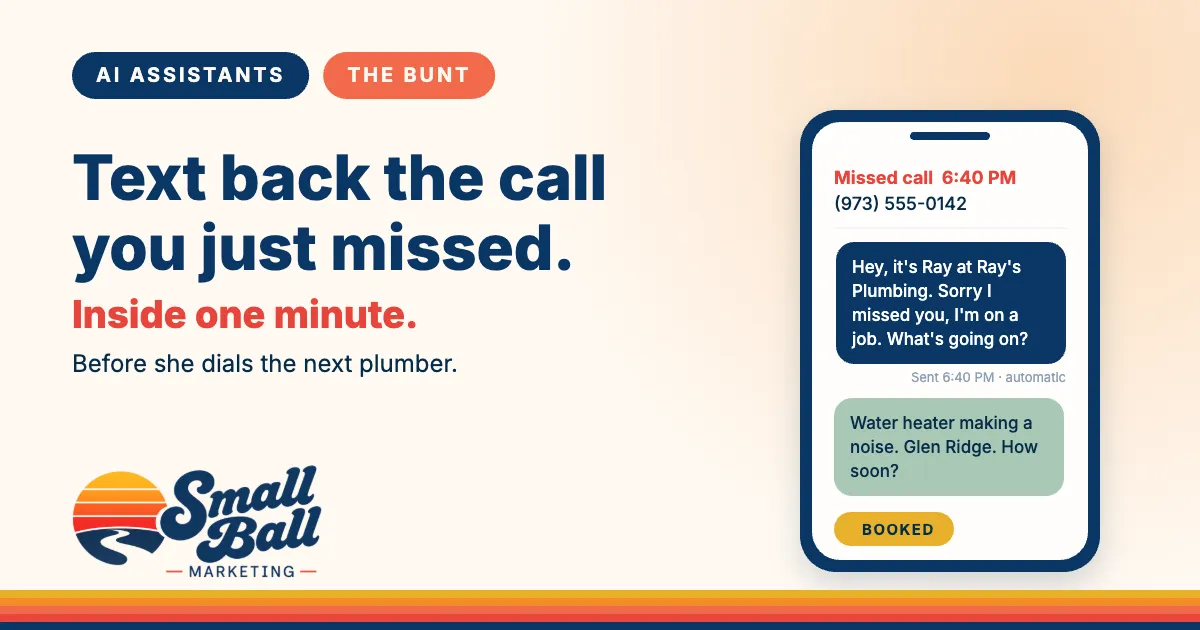
A missed-call text-back does one thing. The moment a call goes unanswered, your phone system sends a text: "Hey, it's Ray at Ray's Plumbing. Sorry I missed you, I'm on a job. What's going on? Text me here and I'll get right back to you." That's it. No robot voice, no press-two-for-service, no "your call is important to us."
What happens next surprises owners. People reply. Not all of them, but far more than will ever leave a voicemail, because texting a stranger is less awkward than talking to one. And now she's in a conversation with you instead of a search results page.
The math, in plain numbers
Say you miss ten calls a week. (Most two-truck shops miss more. Check your call log before you argue with me.) Say half are real jobs, and today you convert almost none of them, because they never call back. If a text-back turns two of those five into booked work, a conservative number for a service call, that's two jobs a week you weren't getting.
At a $400 average ticket, that's $800 a week. Call it $40,000 a year, from a feature that costs less per month than one of those service calls. If your average ticket is bigger, the number gets silly fast. Plug in your own. The shape of it doesn't change.
What to watch out for
Three things, before you buy anything.
The text has to sound like you. The canned version ("Thank you for contacting us. A representative will respond shortly.") gets ignored for the same reason the voicemail did. Write it the way you'd text a customer: first name, what you're doing, one question.
Somebody has to answer the reply. A text-back buys you a few minutes, not an afternoon. If she texts back "water heater, Glen Ridge, how soon?" and hears nothing for three hours, you've missed the same call twice. Either you check it between jobs, or you have an assistant, human or AI, that can answer basic questions and book the appointment.
Check your call log first. Look at last month's missed calls from numbers you didn't know. If it's four, this is a nice-to-have. If it's forty, it's the cheapest money you'll spend this year.
One thing to do this week
Open your recent calls. Count the missed ones from unknown numbers that you never called back. Multiply by your average ticket, then by fifty weeks. That's the number we're talking about.
If you want the text-back set up, plus the assistant behind it that answers questions and books the job, that's what we do. See how we set it up, or let's talk: twenty minutes, no pitch deck.
FAQ
What is missed-call text-back?
A feature of a business phone or CRM system that sends an automatic text to any caller you didn't pick up, within seconds, so the lead can reply instead of hanging up and calling someone else.
Do I need a new phone number?
Usually not. Most setups route your existing business number through the system and forward calls to your cell as before. The text goes out from the same number the customer dialed.
Won't customers find an automatic text annoying?
Not if it arrives in seconds and reads like a person wrote it. A short text is less intrusive than a callback at dinner, and it gives them a way to say what they need without playing phone tag.